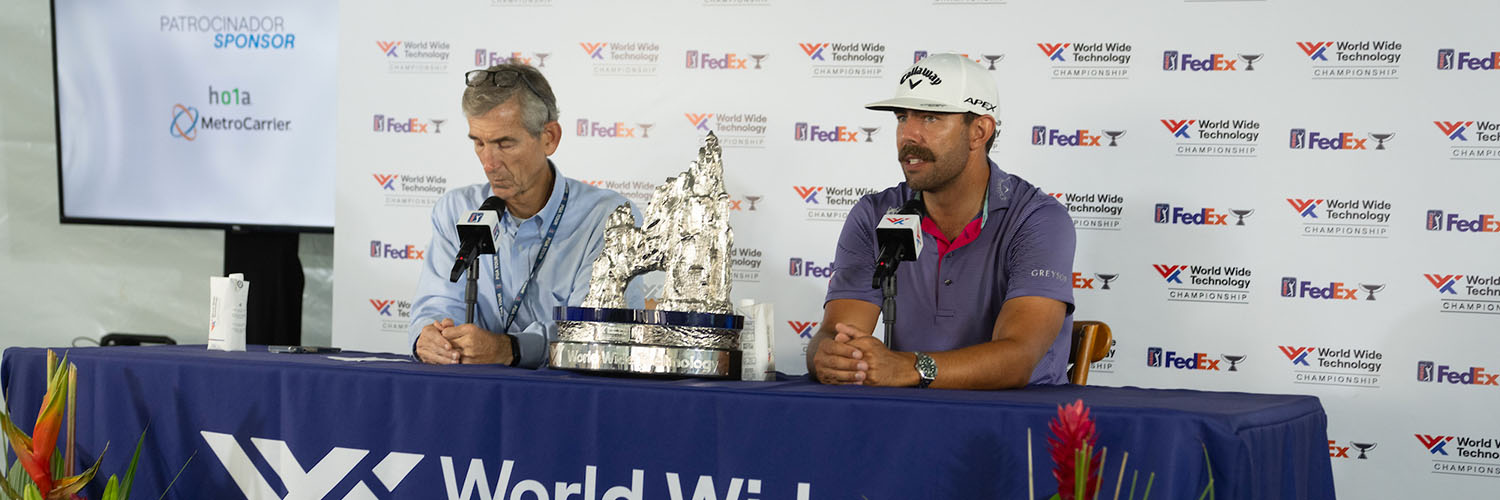
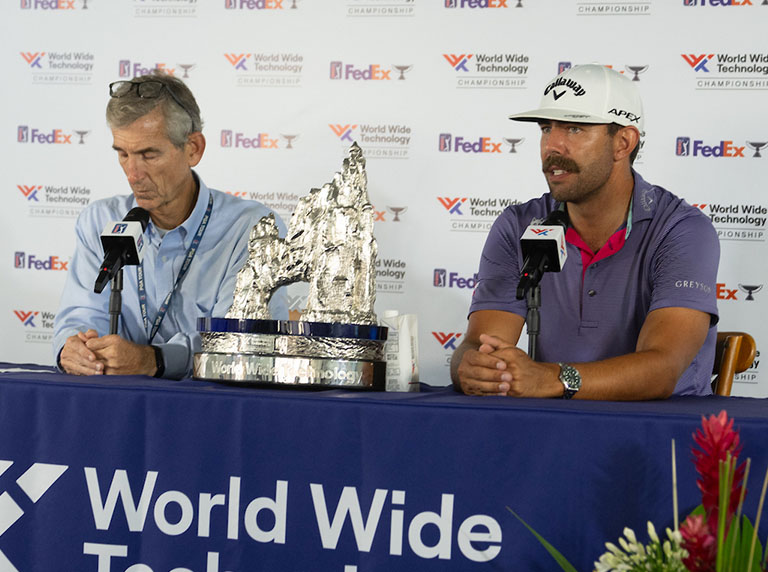
PETER MALNATI: Yeah, thank you. Good score, shot a good score today.
Q. What was working so well?
PETER MALNATI: I made a long one on the first hole, which is fun. Then I actually hit two provisionals in the first four holes, which I'm not sure if you've been on this golf course but that is bad.
But then I straightened it out and actually played solidly from about the ‑‑ from the ninth tee on through the back nine I played really solid golf, which was fun.
Q. Three more events in this PGA Tour season. Where's your head at at the moment?
PETER MALNATI: I don't want this to be my last season on Tour. I've got work to do. I haven't played very well. Obviously there's different ‑‑ like my professional golf career isn't going to end if I don't make 400 FedExCup points the next few weeks. I will, I will scrape and claw like I did in the beginning, but the mountain's going to get a lot taller if I don't play really well these next three weeks.
So my mindset is to go out and be ‑‑ you know, I'm pretty like ‑‑ I really like I don't want to change who I am. I enjoy the game, it's super, super fun for me, and you can only try so hard. So it's not like I'm going to go out and try harder, but I'm really determined to bring it to a different level these next three weeks and just not waste any shots. No shots off, like full focus, I'm really committed to that. So like I said, you can't try any harder, I try as hard as I can anytime, but I don't want to waste any for sure.
Q. Seems like it would be hard to block that noise out and just concentrate on what you're doing.
PETER MALNATI: Yeah, for sure. Sometimes I think it's good just to say it out loud and get it out. That's why I talked to my family and my coaches at the start of this week. Like listen, since the last time I wasn't fully exempt on the PGA Tour was 2015. Long time ago. So I don't want that to change for next year, so there's a lot of work to do.
But once you're out there, the golf ball, the golf ball only knows the physics of what you do to it. Doesn't know the situation, doesn't know what's going on. That stuff always matters, but the golf ball doesn't know it. So I've got to go out there and be focused on my job over every shot.
Q. Going to ask you about the news of the day today.
PETER MALNATI: You're going to have to tell me about the news of the day and then you can ask me about it because I literally am blissfully ignorant.
Q. OK. The news of the day is that LIV is liquidating its assets and winding down operations. So LIV 2.0 is not happening and LIV is for all intents and purposes is dead.
PETER MALNATI: I mean, from the very beginning ‑‑ I'm not an economics major, I'm not even business savvy. I've got some experience now because of my time on the board and friends that I trust to inform me and educate me, but it didn't take too much to see that that wasn't a viable economic model.
So, you know, I don't know ‑‑ obviously I can't get inside the head of anyone that started it. If their goal was truly to be additive to the golf space, they went about it in a strange way. If their goal was to be disruptive, they did a heck of a job.
I think the PGA Tour has responded incredibly well and I'm incredibly proud to be a part of the PGA Tour. Honestly, I feel like PGA Tour emerged from something of a ‑‑ it was never truly like a head‑to‑head battle, but in a way it was because we were trying to keep talent here.
The PGA Tour emerged from what was truly an existential battle in a position where I think we are stronger now than we were before LIV came around. And honestly, I think the golf world, at least the men's professional game can probably, you know, get back to a place now where our business models are going to be based on sound economics and not ‑‑ I think even the Tour in their response to LIV, some of what they did was based on hope.
There was really good planning, really smart people, but you know, like the Tour's immediate response to LIV wasn't economically viable either in the beginning, but they worked hard and made the right decisions to make it so.
Now we're in a place where the PGA Tour never left its spot as the undisputed like, you know, best platform for professional golf or men's professional golf in the world. Now I think because we had to respond to a challenge that had never really existed before, I think the Tour's going to be even stronger moving forward.
Q. I was going to say as someone who was in that room, what are you specifically most proud of over the past couple years? Because there's been all sorts of phases that we've seen with this relationship, but as someone who was in the room helping make these decisions, what gives you the most pride?
PETER MALNATI: I'll tell you one thing and it isn't going to probably be ‑‑ I don't know if history's going to remember this or not in the short term, but Jay Monahan played the cards he was dealt incredibly well. He had a great team around him and he leaned into his team, he trusted his team, but I'm incredibly proud of the courage that he showed through the whole process and the leadership that he showed.
And there were some things that happened in the very beginning that, you know, like to me, like I was sitting in the room and I was kind of panicked about my future. This was my dream job since I was a kid and it looked like the PGA Tour was in real trouble.
Really proud of the fact that like there were drafts of dramatic changes, but if you ‑‑ with the benefit of hindsight looking back on it now, every card the Tour played whether it was developing the Signature Event model, you know, choosing to find a way even before it made economic sense to have some $20 million purses to keep the ‑‑ like things that seemed really reactionary in the moment have played out beautifully.
So I'm proud of the composure of our leaders and the fact that, yes, we made dramatic changes. Some of them were ‑‑ some of them, I hate this term but as a journeyman, yeah, like we're tough to see because like the Tour has shrunk, the Tour's gotten a little smaller, it's gotten more competitive, but with the benefit of hindsight, you look at every card has played and led us to a place now where we're reasserted without a doubt as the premier platform of men's professional golf in the world.
Q. Last one from me. Why do you think the Tour is best positioned and stronger over the next half decade to a decade than it would have been had this crisis not come up?
PETER MALNATI: Yeah, you know, I'm going to quote ‑‑ I'm going to quote something that Rory said and I don't know if ‑‑ but Rory said to me the PGA Tour operates more like a university than a business entity.
I think now it very much is ‑‑ the pieces are in place to hopefully still ‑‑ I hope it doesn't ever lose like the philanthropic heart that it has. The way communities that we go to are impacted by the PGA Tour, I don't think it will ever lose that and I certainly hope it doesn't.
But the Tour also has ‑‑ not instead of that but in addition to that, it now has, you know, an extremely, you know, with the creation of PGA Tour Inc. and a new board, it now has a lot of business sense, too.
So it's not one or the other, I think it's both and, and that's going to make it such a strong like ‑‑ like there will probably be other challengers now. Now that the door has been opened, I imagine there will be other challengers somewhere down the road, but the Tour is now in a pretty darn strong position to carry on.
Credentials may be obtained through an authorized application, which must be completed for admittance. Media credentials are only available for approved, legitimate media outlets and are subject to approval by tournament and PGA TOUR officials.
Sign up for our monthly electronic newsletter “News & Notes from the World Wide Technology Championship” and stay informed on this year’s tournament! We’ll keep you up-to-date on all the exciting developments and also share special offers and behind-the-scenes info.